Selling on Multiple Amazon EU Marketplaces from Portugal: A Complete Operational Guide
Contents expand_more
You can sell on all Amazon EU marketplaces using a single unified seller account, rather than creating separate accounts for each country. This Unified European Account provides consolidated inventory management, combined sales visibility and unified advertising capabilities. The setup simplifies operations, although it requires careful attention to VAT compliance and the choice of fulfilment strategy.
1. Single Account vs. Multiple Accounts
The Answer: One Account for All EU Marketplaces
You only need one Unified European Amazon Account to sell on all EU marketplaces. When you register through any Amazon.eu marketplace (Amazon.es, Amazon.fr, Amazon.de, etc.), your account is automatically configured to access all participating European marketplaces.
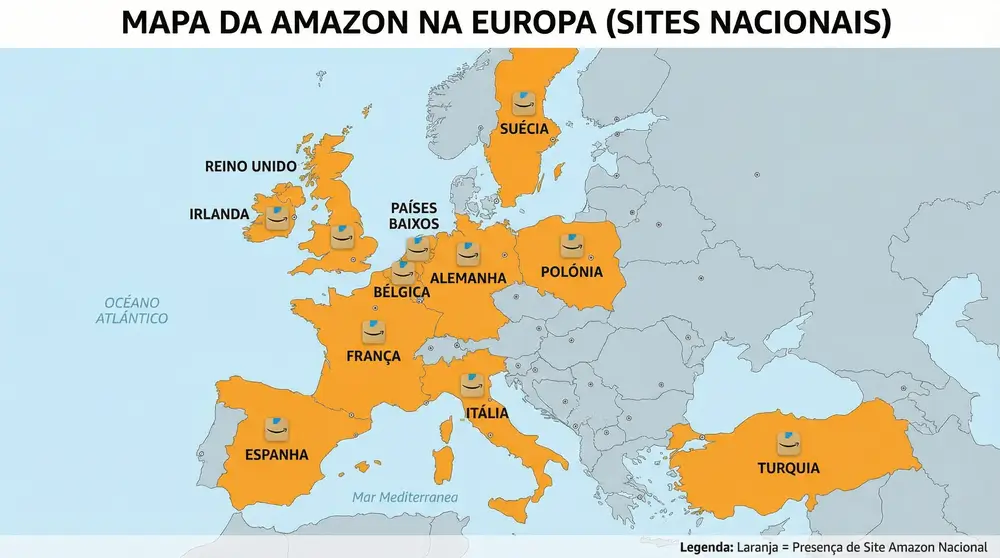
Marketplaces Covered (10 in total)
| Marketplace | Country | | — | | Amazon.co.uk | United Kingdom | | Amazon.de | Germany | | Amazon.fr | France | | Amazon.it | Italy | | Amazon.es | Spain | | Amazon.nl | Netherlands | | Amazon.pl | Poland | | Amazon.se | Sweden | | Amazon.be | Belgium | | Amazon.ie | Ireland |
In addition, your account can include Amazon.com.tr (Turkey), if necessary.
Account Management Benefits
With a unified account, you enjoy several operational advantages:
- Single monthly subscription fee: €39 per month (excluding VAT), regardless of how many EU marketplaces you operate on. This represents a significant saving compared with maintaining separate subscriptions for each country.
- Unified dashboard: Create, manage and adapt product listings across all marketplaces from a single Seller Central interface. You can modify prices, inventory and availability for multiple countries simultaneously.
- Single sign-on: Use the same login credentials for all EU marketplaces and their respective tools.
- Consolidated account information: Update company details, tax records and contact information from one central location that propagates across all marketplaces.
- Combined order management: Track orders from all European sales channels through a unified “Manage Orders” interface or a single combined order report.
2. Stock Control and Inventory Management
Stock management is where the choice of fulfilment strategy becomes critical. You have three main options, each with different implications for inventory control.
The Three Fulfilment Models
European Fulfilment Network (EFN)
EFN allows you to store inventory in a single Amazon warehouse in one EU country (usually Germany, France or Poland) and fulfil orders across all European marketplaces from that location. Amazon ships the products across borders to customers in other countries.
- Advantages: Simplified logistics, lower initial setup costs, limited VAT registration requirements.
- Disadvantages: Slower delivery times (cross-border shipping), limited scalability for high-volume sellers, weaker competitive position in markets far from the storage location.
- Ideal for: Sellers who are just entering the EU market with limited product variety or sales volume.
Pan-European FBA (PAN-EU)
This is the most sophisticated inventory management option and represents the modern best practice for serious EU sellers. You send inventory to a single Amazon fulfilment centre in the EU (France, Germany, Italy, Spain, Poland, Netherlands, Belgium, Sweden, Czech Republic or Ireland) and Amazon’s algorithms automatically distribute your products across fulfilment centres in other activated countries, based on anticipated demand.
Inventory Management and Visibility: The unified dashboard offers real-time visibility of stock levels across all warehouses. You have access to a Multi-Country Inventory Report that shows inventory quantity and status by country. The integrated Restock Inventory tool uses Amazon’s algorithms to forecast demand across Europe and recommends replenishment quantities.
All inventory operates within a unified pool — your 100 units are not duplicated across countries. Instead, the system tracks a single pool of inventory distributed across multiple locations.
Advantages:
Drastically faster delivery times (local logistics in each country).
Prime eligibility on all marketplaces.
Cost-effectiveness (no cross-border fees for participating countries).
Sophisticated demand-based distribution.
Disadvantages: Requires VAT registration in every country where inventory is stored (minimum 2 countries, typically 4-6).
Ideal for: Sellers with consistent sales volume and growth ambitions across several EU markets.
Multi-Country Inventory (MCI)
MCI allows you to manually select which countries to store inventory in and to distribute it yourself among those countries’ fulfilment centres.
- Advantages: Meticulous control over inventory levels specific to each market.
- Disadvantages: Greater operational complexity, requires intensive management.
- Ideal for: Established sellers with deep market knowledge.
3. Advertising Accounts
Amazon has recently modernised its advertising infrastructure, significantly simplifying multi-marketplace campaigns.
Unified Advertiser Account (2025 Launch)
Since late 2025, Amazon has introduced the Unified Advertiser Account that consolidates all advertising products — Sponsored Ads and Amazon DSP — under a single account structure.
- One account for all products: No separate registrations per country.
- Centralised billing: All advertising spend concentrated in one place.
- Unified reporting: Performance analysis for all countries in a single place.
4. VAT Compliance and Tax Registration
This is the most complex aspect of multi-country EU selling and requires careful planning.
VAT Registration Triggers for Portuguese Sellers
As a seller based in Portugal, your obligations depend on the fulfilment model:
| Scenario | VAT Registration Required | | — | | EFN model, sales below €10,000 in the EU | Only in Portugal | | EFN model, sales above €10,000 in the EU | In every country where you sell (or via the OSS scheme) | | Pan-European FBA | In every country where Amazon stores inventory | | Multi-Country Inventory | In every country where you place inventory |
Critical Note: If goods are physically stored in a country via FBA, you must register for VAT purposes in that country — regardless of sales volume.
Portugal Compliance Details
Registration with the Tax and Customs Authority (AT):
- You must hold a NIF (tax number) for a company or sole trader with an open business activity.
- The VAT number (PT+NIF) must be validated in VIES and entered in Seller Central.
VAT rates in Portugal:
- Standard rate: 23% (mainland)
- Rates in Madeira (22%) and the Azores (18%).
One Stop Shop (OSS): If you sell from Portugal to other EU countries (without storing stock in those countries) and exceed the €10,000 threshold, you can use the OSS scheme to declare VAT for all countries through the Portuguese Tax Portal, avoiding multiple registrations. This does not apply to Pan-European FBA, which requires local registrations because of physical storage.
5. Practical Implementation Path for Portuguese Sellers
- Choose the Fulfilment Model: Pan-European FBA is recommended for those seeking growth, due to Prime eligibility.
- VAT registration: Start the process immediately, as it can take 4-6 weeks in countries such as Germany or Spain.
- Register on Seller Central: Go to Amazon.es and register with your Portuguese company details.
- Create Product Listings: Use the “Build International Listings” tool to automatically synchronise and translate your products from Portugal/Spain to the other marketplaces.
- Set Up Advertising: Use the unified account to launch “Sponsored Products” campaigns in the target marketplaces.
6. Fee Structure and Charges (2026)
Monthly Subscription
€39/month (excluding VAT) for unlimited products across all EU marketplaces.
Referral Fees (Sales Commissions)
Recent reductions in force in 2026 for low-value items (≤€20 or ≤€10 in certain categories), with fees dropping to 5% in categories such as supplements and gourmet groceries. Most other categories remain between 8% and 15%.
FBA Fulfilment Fees (January 2026 Reduction)
Amazon has implemented one of the largest fee reductions in the EU:
- Average reduction of €0.17 per unit.
- Low-Price FBA: Products priced ≤€20 benefit from reduced rates, with average savings of €0.40 to €0.45 per unit.
7. Strategic Recommendations
- Phase 1 (Months 1-3): Start with Pan-European FBA focusing on Spain and Germany. These are the marketplaces with the greatest potential for Portuguese sellers due to logistical proximity (Spain) and market volume (Germany).
- Phase 2 (Months 4-6): Expand to France and Italy as demand grows.
- Phase 3 (Months 7-12): Use the Multi-Country Inventory Reports to adjust stock and launch more aggressive advertising campaigns in the best-performing marketplaces.
Conclusion
Selling on Amazon EU from Portugal is simpler than ever thanks to the Unified Account and the new 2026 advertising infrastructure. Success lies in combining efficient logistics (Pan-European FBA) with tax rigour around VAT.